What is Multi Channel Marketing: A Practical Guide
At its core, multi channel marketing is a strategy where a business uses a mix of different communication channels to reach its customers. It's all about being present on multiple platforms—like email, social media, and maybe even a physical shop—so customers can engage with your brand wherever they feel most comfortable.
What Is Multi Channel Marketing Explained

Think of your business like a popular food truck. Instead of forcing everyone to find your single spot, you set up stalls at the local office park, the weekend farmers' market, and a nearby university. That’s the essence of multi channel marketing: you’re meeting customers where they already are.
The goal isn't necessarily to make every channel work together in perfect harmony. Instead, the focus is on maximising your presence across several distinct platforms. Each channel acts as its own independent path for customers to find and connect with you, giving them the freedom to choose their preferred way to interact.
Empowering Customers Through Choice
The core idea is simple: cast a wider net. By offering multiple touchpoints, you naturally increase the chances for potential customers to discover, engage with, and ultimately buy from you. A customer might see one of your posts on Instagram, get a promotional email later, and then finally visit your website to make a purchase.
A multi channel strategy is all about providing options. It accepts that different customers prefer different platforms and gives them the flexibility to engage on their own terms. This simple act of offering choice builds trust and makes your brand feel more accessible.
This approach also lets you tailor your message to fit the vibe of each platform. For instance, a social media campaign can be visual and conversational, while an email campaign might be more direct and promotional.
Common Multi Channel Marketing Channels and Their Roles
For a service business—like a local plumbing service or a healthcare clinic—this strategy can be a game-changer. Different channels serve distinct purposes, from building initial awareness all the way to securing a final booking. The trick is to pick the platforms where your target audience spends most of their time.
Here’s a quick look at how various channels fit into a multi channel strategy for a service-based business.
| Channel | Primary Use Case | Example for a Service Business |
|---|---|---|
| Website | Serves as the central hub for information, building credibility, and enabling direct bookings. | A clinic’s website features doctor profiles, service details, and an online appointment form. |
| Email Marketing | Nurtures existing leads and keeps in touch with past clients. | Sending monthly health tips, appointment reminders, and special offers on check-ups to a subscriber list. |
| Social Media | Builds a community, shares valuable content, and runs targeted ads to find new customers. | Posting daily wellness advice on Instagram and running Facebook ads for a new dental service to a local audience. |
| SMS/WhatsApp | Delivers instant communication for confirmations, reminders, and quick questions. | Sending automated SMS reminders the day before a patient's appointment or answering queries via WhatsApp Business. |
By using a smart mix of these channels, you create multiple gateways for customers to engage with your service, making it easier for them to choose you over the competition.
Why a Multi-Channel Strategy Is Your Business's Growth Engine
In a world where customer attention is pulled in a hundred different directions, just showing up isn't enough. Your potential customers are scrolling through Instagram, chatting on WhatsApp, and searching on Google—often all at the same time. If your business only lives on one of those platforms, you’re basically invisible for most of their day.
This is where a multi-channel marketing strategy comes in. It’s not just another marketing trend; it’s a fundamental shift in how successful businesses operate. It allows you to grab attention and compete effectively, no matter how big or small your company is. By being present wherever your customers hang out, you stay top-of-mind and keep the leads flowing.
Capturing Fragmented Customer Attention
Think of it like putting up signposts on all the roads leading into your town. A customer might drive past the first sign (a social media ad) without a second thought, but then they see another (a promotional email). Finally, after spotting a third (a Google search result), they decide to stop by. This approach makes sure you don’t lose out on business just because you weren’t on the right "road" at the right moment.
This is especially critical in India's booming digital economy. The country’s advertising market is set to blow past the ₹2 lakh crore mark by 2026, and it’s digital that’s in the driver’s seat. Digital channels are projected to take up a massive 68.1% of all ad spending, with small and medium-sized enterprises (SMEs) alone contributing nearly ₹10,000 crore to this growth. As recent industry analysis about India's ad market shows, going multi-channel isn't just an option anymore—it's essential for survival and growth.
Driving Real Business Results
Beyond just getting noticed, a smart multi-channel strategy has a direct impact on your bottom line. It creates more opportunities to turn casual browsers into paying customers. Here’s how it kickstarts growth:
Wider Reach and Brand Awareness: By diversifying your channels, you introduce your brand to entirely new groups of people you would otherwise miss. This fills the top of your sales funnel, creating a steady stream of potential leads.
Deeper Customer Engagement: People have their own preferred ways of talking to businesses. Offering multiple channels—from website chat to SMS—lets them connect on their own terms. This naturally boosts interaction and helps build stronger relationships.
Smarter Data Collection: Every channel is a source of valuable insights into what your customers want. You learn which messages work best on which platforms, letting you fine-tune your approach and get a better return on your marketing spend over time.
By strategically placing your brand across multiple platforms, you build a powerful engine for lead generation and customer acquisition. The goal is to make it as easy as possible for someone to find, engage with, and ultimately buy from you.
Multi Channel vs Omnichannel: Understanding the Difference
You’ve probably heard the terms multi channel and omnichannel thrown around, sometimes even in the same sentence. While they sound similar, the difference between them is a big deal. It all comes down to a simple question: are your marketing channels working for you or for your customer?

Think of it like a chain of coffee shops. If a brand owns several standalone shops that all make great coffee but don't share loyalty points or customer info, that's multi channel. The brand is in multiple places, but each one is its own little island.
The Brand-Centric Approach of Multi Channel
With a multi channel strategy, the brand is the hero of the story. The main goal is to get the message out far and wide, using every relevant platform available. Each channel—whether it’s a Facebook page, an email list, or a physical store—runs its own race with its own goals.
This gives you some flexibility. You can run a "like and share" giveaway on Instagram while sending an exclusive discount code to your email subscribers. The channels don't really talk to each other, and that's okay. They’re all just focused on reaching an audience.
The Customer-Centric World of Omnichannel
Now, imagine that coffee shop chain got a major upgrade. An omnichannel approach connects every single shop. A customer can browse the menu on their mobile app, order ahead for pickup at any location, and watch their loyalty points update in real-time. The customer is at the heart of everything.
Omnichannel marketing isn’t just about being on multiple channels; it’s about creating a single, seamless, and continuous journey for the customer across all of them.
This creates a smooth, connected experience. If a customer adds a product to their cart on your website, they might see a reminder ad for that same product pop up on their social media feed later. Every touchpoint shares data to build a consistent and personal journey. It’s a bigger technical lift, for sure, but it’s what builds serious customer loyalty.
Multi Channel vs Omnichannel: A Head-to-Head Comparison
So which one is right for you? It really depends on your business's resources, goals, and where you are in your growth journey. For a lot of businesses, starting with a multi channel strategy is the practical choice before leveling up to a more integrated omnichannel model.
Here’s a quick breakdown of the key differences:
| Aspect | Multi Channel Marketing | Omnichannel Marketing |
|---|---|---|
| Primary Focus | The brand and its message. | The customer and their journey. |
| Channel Integration | Channels operate independently in silos. | Channels are fully integrated and work together. |
| Customer Experience | Disconnected; experience differs by channel. | Consistent and seamless across all touchpoints. |
| Data Strategy | Data is often siloed within each channel. | Centralised data provides a unified customer view. |
Ultimately, moving from a brand-focused to a customer-focused mindset is what separates these two powerful strategies. One casts a wide net, while the other weaves a strong, interconnected web.
Choosing the Right Channels for Your Audience
So, you understand the what of multichannel marketing. Great. But that's just the starting point. The real million-rupee question is: which channels will actually grow your business?
Throwing everything at the wall to see what sticks—a scattergun approach—is a fantastic way to waste time and money. The secret isn't being everywhere; it's being everywhere your customers are. The key is to strategically pick the platforms where your specific audience already hangs out, ready to engage.
For most service businesses, the most powerful channels are the ones that spark instant conversations. Picture this: a potential customer's pipe has just burst. They don't have time to fill out a form and wait for an email. They need a plumber, now. This is where platforms like WhatsApp Business and live website chat become goldmines for immediate lead capture and turning a crisis into a conversion.
This simple principle—meeting customers in their moment of need—is what separates a decent strategy from a brilliant one.
Identifying Your Core Channels
So, how do you build an effective channel mix? You start by putting on your detective hat and analysing your customer's behaviour. Don't just guess where they are; use data, observation, and a bit of common sense.
Are they frantically Googling for solutions? Asking for recommendations in local Facebook groups? Or are they the type to jump on an SMS offer? Once you have this insight, you can handpick channels that fit their habits like a glove.
Here are a few modern, high-impact options to get you thinking:
Social Media: Platforms like Instagram and Facebook are perfect for telling your story visually and building a community. Plus, with social commerce features, you can sell directly from your posts. A good social media scheduler can make managing this a breeze.
Instant Messaging (WhatsApp/SMS): These are your go-to tools for appointment reminders, quick follow-ups, and personalised offers. The direct, immediate nature of these channels makes them incredibly effective, especially for service-based businesses.
Webinars and Online Events: If you're a coach, consultant, or B2B company, this is your stage. Webinars are ideal for educating your audience, demonstrating your expertise, and nurturing leads in a structured, high-value format.
The digital shift in India makes this selection process more critical than ever. We're talking about a nation with over 900 million mobile internet users. The demand for hyper-personalised campaigns across email, social media, and WhatsApp is absolutely surging. In fact, India's digital ad space is on track to blow past ₹69,856 crore by 2026, all fuelled by smart multichannel strategies that blend search, social, and even in-store tactics.
Leveraging Niche and Regional Influence
Don't just think big; think smart. Beyond the mainstream platforms, there's immense power in targeted, local influence. While a big-name celebrity influencer has reach, regional micro-influencers often deliver something far more valuable: trust and engagement.
Partnering with a local food blogger in your city or a neighbourhood wellness coach can be infinitely more effective than a generic, one-size-fits-all ad campaign. These influencers have a dedicated following that genuinely trusts their recommendations, often leading to conversion rates as high as 6-10%.
Ultimately, building your multichannel marketing plan is an exercise in making smart, informed choices. It’s about figuring out where your customers spend their digital lives, picking the platforms that offer the most direct path to them, and focusing your precious time and resources on the channels that will actually deliver a return.
Do that, and you're not just marketing—you're building a powerful, efficient system for attracting and converting leads.
Putting Your Multi-Channel Marketing Strategy Into Action

Knowing the theory is one thing. Putting it into practice is where the real growth happens.
Executing a solid multi-channel marketing plan might seem daunting, but it becomes much simpler with the right framework. It all boils down to solving one core business problem: capturing every single lead, no matter where it comes from, and turning it into a customer.
A unified platform like Aadir is built to be your central command centre. It pulls inquiries from all your channels—website forms, SMS, WhatsApp messages, and even phone calls—into a single, manageable inbox. This ends the chaos of juggling multiple apps and makes sure no lead ever falls through the cracks.
Step 1: Capture and Respond Instantly
The first few minutes after someone shows interest are everything. A slow response almost always means a lost opportunity. This is where AI-driven automation becomes a small business’s secret weapon.
By setting up an AI assistant, you can guarantee a response in under 90 seconds, 24/7. Whether a potential client fills out a form on your website at 2 AM or sends a WhatsApp message during a busy workday, they get an immediate, helpful reply. This instant engagement not only impresses prospects but also starts qualifying them, freeing up your team to focus on high-intent leads.
This rapid, automated response system ensures you are always the first to reply, dramatically increasing your chances of converting a new lead before your competitors even see the notification.
That first interaction sets a professional tone and shows customers you value their time. Trust is built right from the start.
Step 2: Automate Nurturing and Follow-Up
Once a lead is captured, the real work begins: guiding them towards a purchase without spending all your time on manual follow-ups. This is where you can truly explore what marketing automation can do for your business. It allows you to send a series of personalised emails or SMS messages over days or weeks, all on autopilot.
This automated nurturing keeps your brand top-of-mind. For instance, you could set up a simple sequence that:
- Sends a welcome email with valuable information right away.
- Follows up two days later with a relevant case study or testimonial.
- Offers a special discount a week later to encourage a final decision.
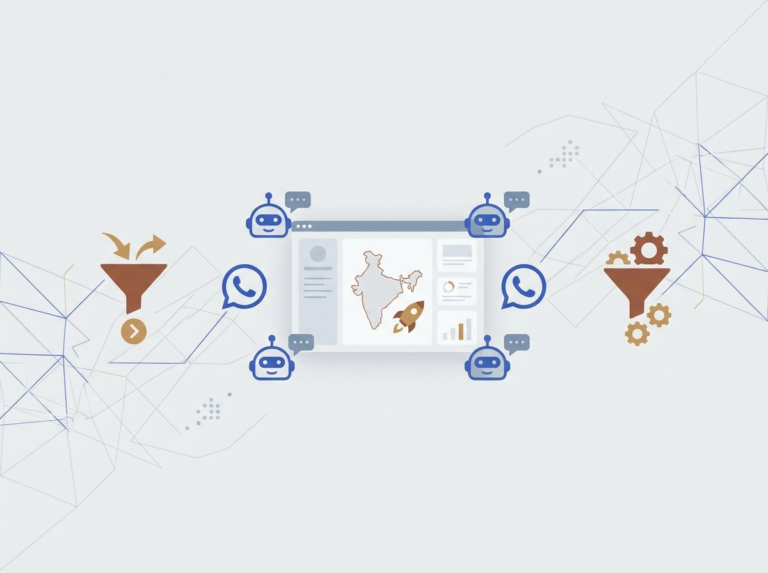
The infographic above breaks down this entire process: identifying where your audience spends their time, choosing the right channels to reach them, and funnelling those interactions into tangible leads. A unified platform simplifies this by managing all those channels and leads from one organised dashboard.
The growth potential for businesses in India adopting these strategies is massive. The market for multi-channel marketing is projected to explode from USD 14.66 billion toward USD 32.14 billion by 2030, driven by AI-powered personalisation and the integration of platforms like WhatsApp and SMS. With SMEs expected to contribute over ₹10,000 crore in new ad spend, having a system to capture and convert that interest is no longer optional—it's essential for survival and growth.
Measuring the Success of Your Multichannel Efforts
A great multichannel marketing strategy is only as good as the results it produces. But how do you know if it's actually working? To truly understand its impact, you have to move beyond surface-level metrics like social media likes and followers.
The real focus should be on Key Performance Indicators (KPIs) that directly tie back to your business's health and growth.
Tracking the right data isn't just a nice-to-have; it's non-negotiable. It tells you what’s working, what’s not, and where to put your money for the best returns. This is where a unified analytics dashboard becomes essential, bringing all your channel data into one place for a clear, complete view of your performance.
Key Metrics That Truly Matter
To prove the value of your efforts, you need to concentrate on the numbers that connect directly to revenue and customer happiness. This data-driven approach is what allows you to confidently show the return on investment (ROI) from all your multichannel activities.
Here are the essential KPIs you should be tracking:
- Lead Response Time: This measures how quickly your team engages with a new enquiry. A fast response, ideally under 90 seconds, dramatically increases the odds of converting a lead into a customer. It's often the make-or-break metric.
- Conversion Rate by Channel: This shows you which of your platforms—whether it’s WhatsApp, website chat, or email—is most effective at turning prospects into paying customers. It helps you double down on your most profitable channels.
By analysing these core metrics, you shift from simply being active on multiple channels to strategically investing in the ones that deliver tangible business results. This is the heart of effective multichannel marketing.
Connecting Metrics to Business Growth
Beyond those initial conversions, it’s vital to understand the long-term value your marketing creates. This is where deeper financial metrics come into play, helping you make smarter, more sustainable decisions about your budget and strategy. You can learn more about how to connect your data by exploring our complete guide to marketing analytics software in India.
Two critical metrics for this are:
- Customer Acquisition Cost (CAC): This tells you exactly how much you spend, on average, to gain a new customer through each specific channel. A low CAC is a sign of an efficient marketing machine.
- Customer Lifetime Value (CLV): This forecasts the total revenue your business can expect from a single customer over their entire relationship with you. A high CLV means you are not just attracting customers, but retaining valuable, loyal ones who keep coming back.
Frequently Asked Questions
When you start digging into multichannel marketing, a few practical questions always pop up. Let's tackle some of the most common ones we hear from business owners just like you. Getting these answers sorted is the first step to moving forward with confidence.
How Much Does a Multi Channel Campaign Cost to Start?
This is the big one, right? The good news is, you don't need a massive budget to get started. Multichannel strategies are incredibly scalable. You can kick things off with completely free tools like a Google Business Profile and a few social media accounts to carve out your initial online space.
The trick is to start smart, not big. From there, you can layer in affordable, high-impact channels. The goal isn't to spend a lot of money upfront, but to focus your initial efforts on the channels that give you the biggest bang for your buck.
Which Channels Are Best for a Small Service Business?
If you're running a small service-based business, you can get a huge amount of traction by focusing on a core trio of channels. Forget trying to be everywhere at once. Start here for the best results:
- A professional website with a chatbot to make sure you never miss a lead, even at 2 AM.
- A dedicated business WhatsApp number for that instant, personal connection customers love.
- A strong local SEO presence to get in front of people who are actively looking for the services you offer.
This combination makes you visible, easy to reach, and ready to turn a casual query into a booked appointment.
Can I Manage Multi Channel Marketing Without a Big Team?
Absolutely. In fact, modern all-in-one platforms are built for exactly this scenario—the solo entrepreneur or the small, scrappy team. Thanks to built-in AI and automation, you can manage conversations across all your channels from one place.
These tools do the heavy lifting, ensuring every customer gets a quick, professional response without you needing to hire a big team to handle it all.
Ready to unify your marketing and stop letting leads slip through the cracks? Aadir's AI-powered platform helps you respond to every single inquiry in under 90 seconds, 24/7. Start your free trial and see how it works.
Written with Outrank app